
July 21, 2026, 2:04 pm
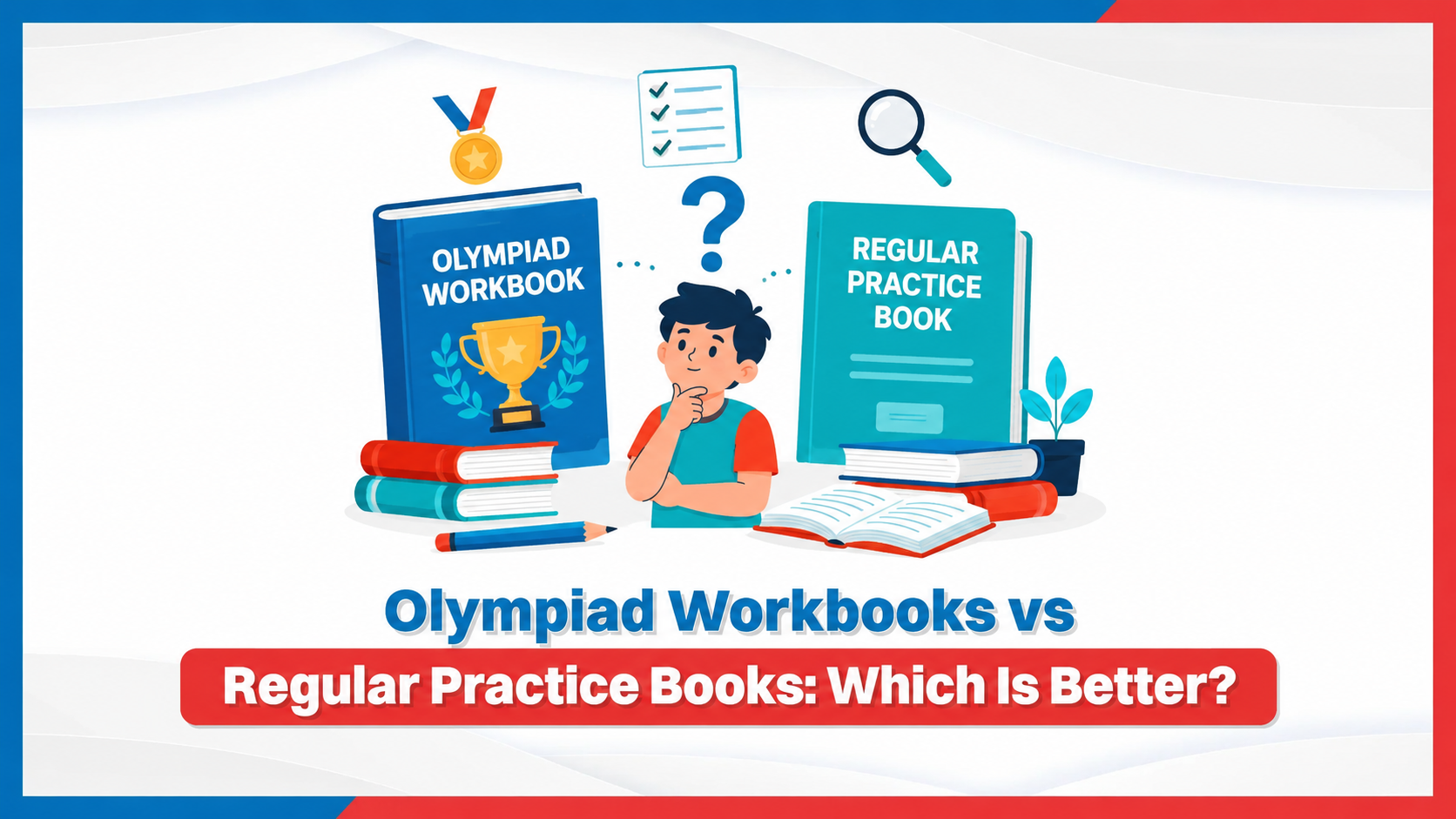
Being a parent, picking the right books for your kids could be an extremely difficult decision to make. Whether you visit any physical bookshop or do some online surfing, you will encounter numerous choices ranging from standard textbooks to specialised books for competitions. There is one constant query raised by many parents, which goes like this: "Should I get olympiad books for my kid or go for practice books?"
The truth of the matter is that there isn't always one right answer. In fact, the choice largely depends upon the academic requirements of your child and his or her grade level. This blog has all the details for you.
The main aim of regular practice books is that they are aligned with the syllabus followed in the school, which is usually the CBSE, ICSE, or state board syllabus. The main purpose of these books is to enable students to:
Go through topics covered in class
Practice questions based on the examination pattern
Perform well in the examinations conducted in school
These books follow the pattern of the book in terms of chapters. Most of the questions covered are direct and test your knowledge about a topic and understanding of the same. These books serve as the best means to form a good base and make sure your child does not lag in his school studies.
Olympiad study material is purpose-built for competitive examinations like the SOF Olympiads, ASSET, NSTSE, IMO, and similar national-level contests. These aren't just harder versions of school books; they think differently.
Here's what sets them apart:
Rather than testing what a child remembers, olympiad-level questions test how well they apply, analyse, and reason. A question won't just ask "What is photosynthesis?" It might ask students to compare two scenarios and identify which plant would survive and why.
Olympiad material typically goes one level deeper than the school curriculum. It introduces concepts that children will encounter in higher grades, giving them an academic head start.
These books train children to think under time pressure, handle tricky distractors in MCQs, and approach unfamiliar problems with confidence – skills that pay off well beyond the olympiad stage.
Olympiad Workbooks: A Closer Look
Oswaal Books Olympiad workbooks are problem-solving guides that are normally accompanied by the olympiad course book. Consider these workbooks as the 'practice and learn' books, which include the following:
Many practice problems, organized from easy to difficult
Previous years' question papers
Sample tests that resemble actual olympiad exams
Answer key with detailed explanations
Olympiad workbooks are particularly important since kids learn through practice. A kid that learns only the theory is unlikely to perform well in the olympiad. However, a kid that practises using a good workbook will develop speed and accuracy.
Mathematics is one of the most popular olympiad subjects, and for good reason: strong maths reasoning is the backbone of engineering, science, and even finance careers. Oswaal Books Maths olympiad books are designed to build the following:
Number sense and mental maths
Logical reasoning and pattern recognition
Problem-solving strategies like working backwards, trial and error, and elimination
Geometry intuition and data interpretation skills
The biggest difference you'll notice between a maths olympiad book and a regular maths practice book is the type of problems. Olympiad maths problems often have a "puzzle feel";; they're engaging, challenging, and deeply satisfying to solve. Many children who find regular maths boring find olympiad maths genuinely exciting.
A science olympiad book by Oswaal Books is more than just diagrams and definitions in textbooks. It teaches kids to be scientific thinkers by making observations, forming hypotheses, and coming to conclusions through experiments. The subjects are discussed in more depth, and many times, the questions require kids to
Apply scientific concepts to real-life scenarios
Analyze graphs and data from experiments
Reason across multiple topics (such as biology and chemistry)
Science olympiad books can be truly engaging for kids who are naturally curious about the world around them.
|
Feature |
Regular Practice Books |
Olympiad Books & Workbooks |
|
Curriculum alignment |
School syllabus |
School syllabus + beyond |
|
Question type |
Recall & basic application |
Analysis, reasoning, HOTS |
|
Difficulty level |
Moderate |
Moderate to advanced |
|
Exam preparation |
School exams |
Competitive olympiad exams |
|
Thinking skills developed |
Foundational |
Critical & logical thinking |
|
Best suited for |
All students |
Students aiming to compete or excel |
|
Engagement level |
Functional |
Often more challenging & stimulating |
Which One Should Your Child Use?
A straightforward framework for parents is below:
Go for regular practice books if your child:
Is consolidating school knowledge yet
Has difficulties with the basic things and requires extra repetitions
Would like to increase school examination results first
Go for olympiad preparation books if your child:
Mastered school knowledge already
Is curious, likes challenges and gets bored easily
Would like to develop critical thinking skills for future academic success
Is going to participate in an olympiad examination
Go for both of them if your child:
Is a well-balanced student requiring preparation for both types of examinations
Would like to achieve school scores and an olympiad success
Quite many parents agree that regular practice books should be preferred to olympiad workbooks until Grade 3 and then both of them in Grade 3 and later. When children become middle-schoolers, it is beneficial for them to practise both types of books.
Even with the best books, preparation matters. Here's how you can support your child:
Start early, practise consistently: 20–30 minutes of olympiad practice daily is more effective than cramming before the exam.
Don't focus only on scores: The thinking process matters more than the right answer at this stage.
Discuss problems together: Ask your child to explain their reasoning. This deepens understanding.
Use model papers: Timed mock tests build exam temperament.
Celebrate effort, not just outcomes: Participating in an olympiad is itself a significant achievement.
Conclusion
There is no single answer to which type of book is better – olympiad ones or standard ones. They are designed to solve two different tasks.
In case your aim is to help your kid develop self-confidence and curiosity about learning, as well as give him the ability to cope with any challenge, working on olympiad books can be considered an excellent choice. The benefits of doing this kind of work cannot be underestimated even when the olympiad becomes a part of the past.
Start from the level of your kid. Push him hard enough to progress but not too much. Keep in mind that the best book is the one your kid reads.
1: At which stage should my child begin practising olympiad books?
The majority of olympiad books are found even from Class 1. But grades 2–3 could be a good beginning level for most children who have some basic understanding about reading and mathematics.
2: Can the practice of olympiad preparation adversely affect my child’s performance in school?
Absolutely not; on the contrary, it improves his/her performance at school. Because olympiad practice involves the study of concepts taught in schools at a deeper level, most children find it easy to attempt school examinations after regular olympiad practice.
3: How much time per week should my child spend in practising for olympiad examinations?
3–4 hours per week are adequate for Classes 1–5, while 5–6 hours per week could be the target for Classes 6–8.
4: Should my child join a coaching class for olympiad preparation?
No, there is no necessity of joining any coaching classes for preparing for olympiad exams.