
June 25, 2026, 4:29 pm
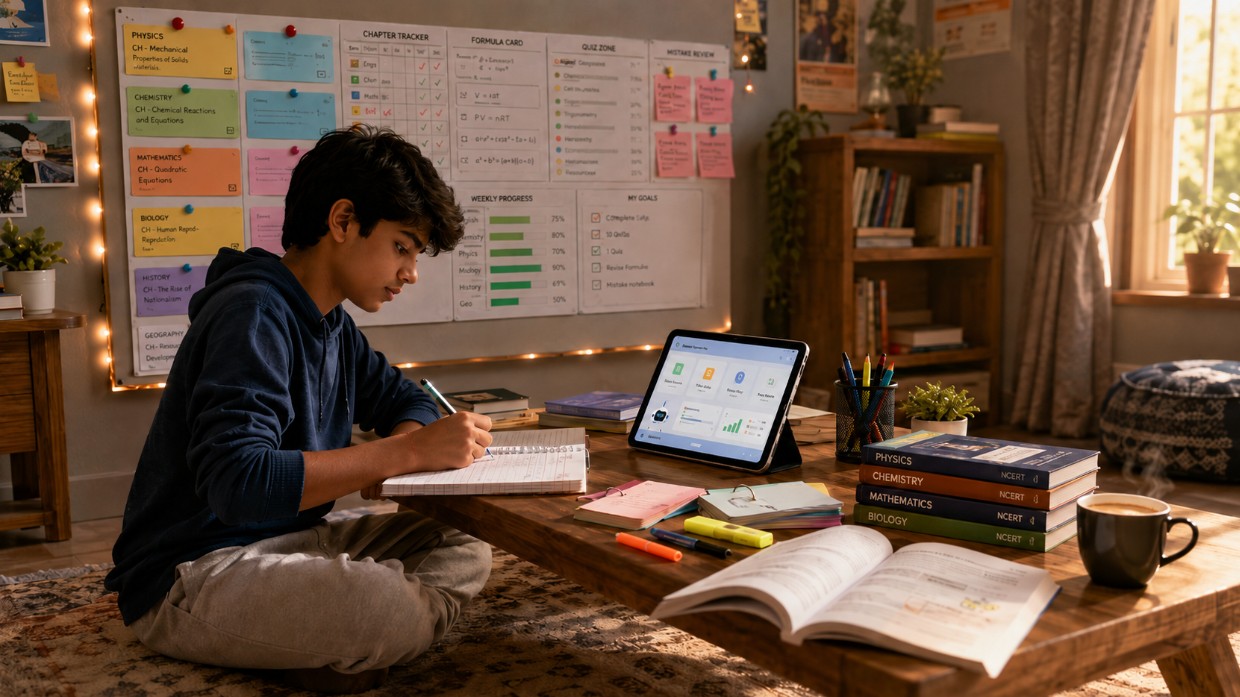
Most Class 10 and 12 students who try AI tools for studying end up using them the wrong way, either copying answers straight into their notebooks or asking vague questions and getting vague answers back. The result is a lot of time spent and not much actually learned.
But when you use AI with intention, it changes the texture of revision entirely. You stop being a passive reader of your notes and start actively testing yourself. That shift from reviewing to retrieving is what actually moves marks.
Here's a practical guide to making AI work for CBSE preparation, based on how the exam actually tests you now and how free mobile apps like Edzy can support that process without replacing the effort that actually builds understanding.
CBSE has steadily moved away from straightforward recall-based questions. Today's Board papers, especially in Science, Social Science, and Business Studies are built around case-based questions, assertion-reason formats, and competency-based problems that require you to apply what you know, not just reproduce it.
Reading your NCERT chapter three times doesn't prepare you for that. Attempting questions that mirror that format does.
This is exactly where AI becomes useful. Not as something that does your studying for you, but as something that can generate the right kind of questions on demand, timed to what you've just studied, specific to the chapter, and matching the question formats that actually appear in Board papers.
The three question types that have increased most sharply in recent CBSE Board papers are case-based questions, competency-based questions, and assertion-reason questions all of which test application, not memory. Students who practise these formats specifically, rather than generic MCQs, consistently report feeling more prepared on exam day
After finishing a chapter for example, Chemical Reactions and Equations in Class 10 Science, ask an AI tool to generate:
5 MCQs with one application-based question included
2 assertion-reason questions
1 case-based question based on a real-world scenario
3 three-mark short answer questions
You'll have a mini test ready in under a minute, built around exactly what you just studied.
The key is specificity in your prompt. "Give me questions on Chapter 1 Science Class 10" produces generic output. "Give me 3 competency-based questions on the types of chemical reactions from NCERT Class 10 Chapter 1, similar to CBSE Board Exam format" produces something actually usable.
For students who want questions that are already mapped to NCERT learning outcomes without having to prompt carefully each time, platforms like Edzy offer chapter-wise CBSE model questions built specifically around Board Exam expectations useful when you want structured, curriculum-aligned practice rather than AI-generated questions that may need fact-checking.
One of the most underrated things AI does well is breaking down difficult concepts at whatever level of simplicity you need.
Struggling with electromagnetic induction? Ask for an explanation using the example of a bicycle dynamo. Not satisfied? Ask it again, simpler. Still confused? Ask it to walk through just the first step of the derivation, nothing else.
You control the pace. That's something a classroom of forty students rarely allows.
The important rule here: treat AI explanations as a starting point, not a final answer. For anything involving a definition, a formula, or a fact that might appear in your Board paper, cross-check against your NCERT textbook. AI can and does make mistakes confidently, fluently, and occasionally in ways that are hard to spot. Use it to understand the logic of something, then verify the specifics in your textbook.
Here's a technique that most students haven't tried but genuinely works: write a five-mark answer from memory, without looking at your notes, then paste it into an AI tool and ask:
"I'm a Class 10 student preparing for CBSE Boards. Review this answer and tell me: which key points are missing, whether the structure matches CBSE expectations, and which NCERT keywords I should have included."
The feedback you get is specific and immediate. You'll quickly see whether you're actually retaining what you think you are, or just feeling like you are because you've read it before.
This method, called active recall, is backed by decades of memory research. The act of trying to retrieve information, even imperfectly, strengthens retention far more than re-reading does. AI makes it practical for individual students to do this repeatedly, across subjects, without needing a teacher present for every session.
Edzy is built around this exact model, every subject and chapter has a dedicated question set designed to be attempted, not read, so the retrieval practice happens by default rather than by discipline
AI hallucinates. This is the technical term for when a language model generates something that sounds completely correct but is factually wrong. In a CBSE context, this could mean an incorrect chemical formula, a misattributed historical date, or a definition that sounds like NCERT language but isn't.
The risk is real and worth taking seriously. A student who memorises an AI-generated definition that's subtly wrong will carry that error into the Board exam.
The safeguard is simple: never use AI as a primary source. Use it to understand, clarify, and generate practice, then verify everything factual against your NCERT textbook or your teacher's notes. When Edzy generates practice questions, they're drawn from a curriculum-mapped bank rather than generated on the fly, which is one reason students use both AI tools for flexibility, curated platforms for reliability.
If you haven't used AI for studying before, start small. After your next chapter, try this:
Write a five-mark answer from memory.
Paste it into an AI tool and ask for feedback against CBSE expectations.
Note what you missed. Revise just those gaps.
Then ask the AI to generate five questions on that chapter for tomorrow's practice.
That's a complete active recall cycle. Do it consistently and your revision stops feeling like going through motions.
The students who get the most out of AI aren't the ones using it the most, they're the ones using it with a clear purpose each time.