
August 27, 2026, 8:53 pm
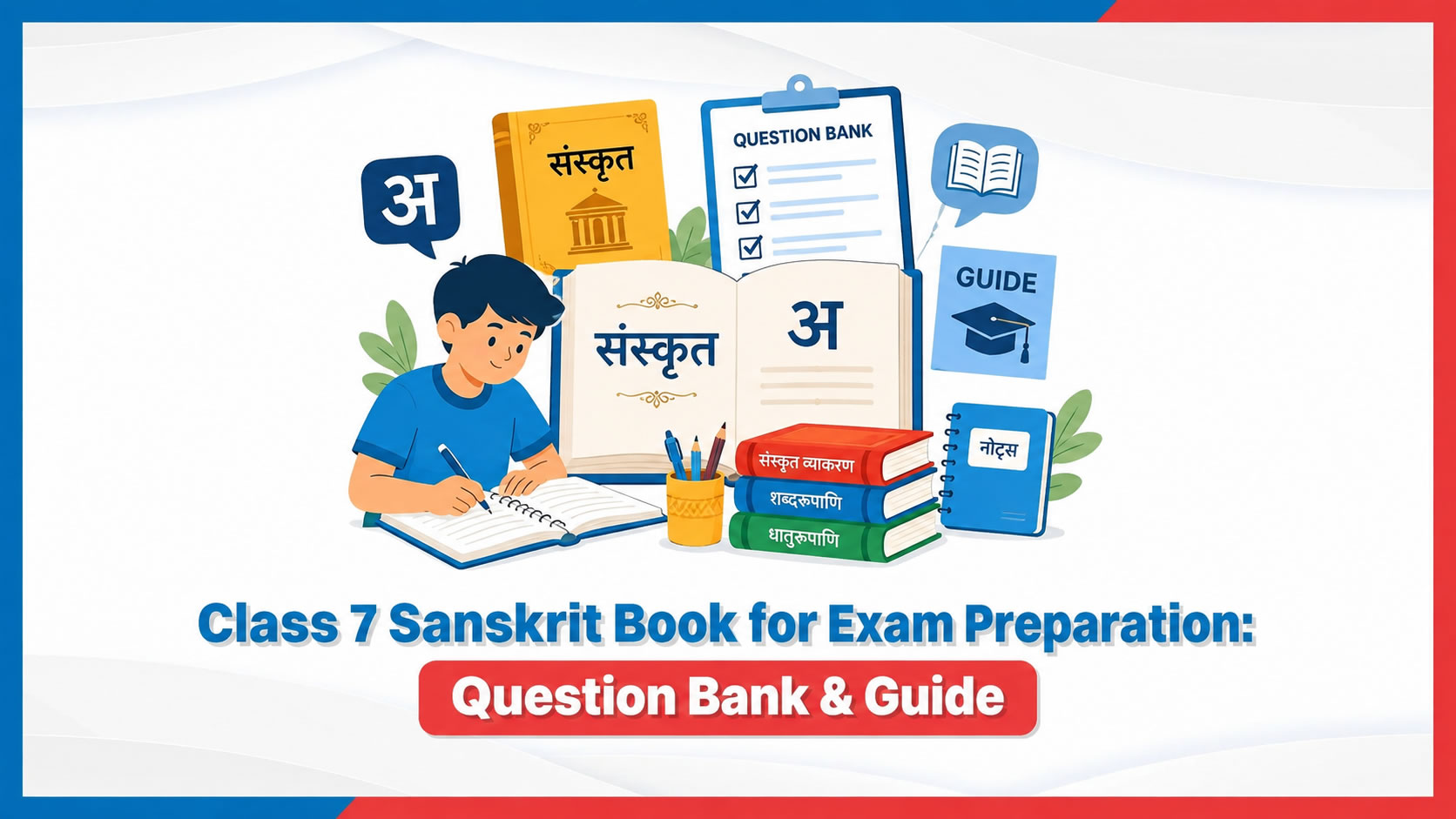
Sanskrit in Class 7 is more about vocabulary, grammar, sentence structures, and literary passages. So, a lot of practice is required to build up confidence for the exams. A Class 7 Sanskrit book that has a structured plan helps students practice Class 7 Sanskrit question answers, perfect their grammar, and prepare for the type of questions that will be on the exams. Samples and practice papers provide different structures that fulfil different needs in the overall preparation for Class 7 Sanskrit. This guide explains to students the best use of these resources for effective preparation for Class 7 Sanskrit exams.
Class 7 Sanskrit books must have a revision and practice segment for each chapter.
Class 7 Sanskrit question answer segments provide the basis for understanding and practising answers to questions.
Class 7 Sanskrit guides must simplify complex concepts.
Class 7 Sanskrit grammar practice reduces the number of mistakes in exams.
Class 7 Sanskrit important questions are best used for revision after understanding the syllabus.
Class 7 Sanskrit sample papers provide a measure of the preparation and help with time management.
A practice book must have a range of questions and not repeated questions.
Class 7 Sanskrit workbooks offer the opportunity for uninterrupted practice throughout the year.
Question banks need to be used in combination with the prescribed textbook and class activities.
Class 7 Sanskrit can be a curious subject on its own, but it can be difficult for students to rely on last-minute memorisation for exam preparation. At this stage, Sanskrit learning involves vocabulary, comprehension, grammar, sentence structure, translation and interpretation. Opportunities to practice each of these need to be provided regularly.
With a well-researched Class 7 Sanskrit book, the learning process will be more organised. There is no need to look for questions in different places anymore. Students can now revise chapters, practice grammar and evaluate their progress with a single resource structured in a planned manner.
Buying a book with questions and answers won't automatically yield better scores. Along with the textbook and the lectures, the resource has to be used after understanding each lesson. Then, the book can be used to practice, to revise and for self-assessment.
A question bank can be used to answer focused practice after each lesson has been studied.
The bank can include chapter passages and provide their meanings and vocabulary. Important chapter questions can also be included.
A quality question bank could present the following:
Short-answer questions
Long-answer questions
Fill-in-the-blank questions
Match the following questions
Translation exercises
Vocabulary
Grammar
Comprehension questions
This gives students practice for different types of assessment questions.
Some students have strong vocabulary skills, but weak grammar skills. Other students may have strong grammar skills, but have trouble translating. A question bank can identify these issues.
Rather than having to read the entire textbook repeatedly, students can answer review questions to determine what they remember.
When selecting a Class 7 Sanskrit book, students and parents should look at the book beyond the page count. A resource worthy of the page count should cover important aspects of the syllabus.
Chapter-Wise Content: Exercises should be correlated with respective lessons/ chapters.
Clear Explanations: Complex terms and grammar should be explained with language that Class 7 students comprehend.
Practice Questions: Questions should be formulated to test both direct recall and conceptual understanding.
Grammar Exercises: Grammar should be given good emphasis. It is particularly important for Sanskrit to be written accurately.
Revision Material: Short revision sections should be included for students to review concept prerequisites of upcoming assessments.
Sample Papers: A Class 7 Sanskrit sample paper can be a good way to practice the complete examination.
Practice of Class 7 Sanskrit question answers should be done. However, students should refrain from memorising the answers word for word without understanding the concept.
A better method is:
Step 1: Read the Chapter: Understanding the main points of the chapter should be the objective of reading the chapter.
Step 2: Learn the Vocabulary: Understanding the meaning of new words should not be neglected.
Step 3: Attempt Questions Independently: Before you look at the answers, try to provide your own.
Step 4: Compare Your Answer: Now see whether you have answered each of the important points.
Step 5: Revise Mistakes: Rework your answers where required.
This method is useful for both comprehension and writing skills.
A Class 7 Sanskrit Guide is best used to solve problems or explain lessons that are difficult to understand.
However, guides should not be substituted for textbooks.
Use a guide for the following:
Explaining difficult parts of a text
Meanings
Reviewing grammar
Practice questions
Answering questions
Revising key concepts
For example, if a student cannot understand the meaning of a Sanskrit passage, the guide can provide the meaning. After understanding it, the student should then move on to the textbook and answer the questions independently.
This method promotes genuine understanding of the lesson and the answers, rather than simply memorising the answers.
Certain simple steps can make the preparation for grammar easier.
Learn the Rule: Understand both the meaning of the grammar rule and the context in which it is used.
Study Examples: Look at the examples that are provided in the textbook or the study material.
Practice Simple Questions: Start with very simple examples.
Increase Difficulty: Once the basic questions become familiar, do more difficult examples.
Revise Regularly: Revise difficult forms frequently.
Students should also maintain a small notebook with important rules, examples and common mistakes. This is very useful for examination revision.
Before an examination, students search for class 7 Sanskrit important questions. Such questions can help in organising your preparation, but students should not rely on anticipated questions. Different formats can be used to assess the same concept.
Identify the crucial areas by looking at the following:
Questions that are emphasised in the textbook
Concepts that are frequently practised in class
Areas of grammar that need to be applied
Important vocabulary
Comprehension and translation
Passages where the concepts of grammar and vocabulary are tested
Mistakes that students tend to make
This method is far safer than committing to memory a list of retained questions.
They should be done after completing a substantial portion of the syllabus. Unlike chapter-wise worksheets, sample papers incorporate several different sections and subsections of the syllabus. Sample papers are beneficial because they:
Help students become familiar with the structure of the assessment.
Practice answering in time-bound situations.
Help students determine weak areas.
Help students write faster.
Improve question selection.
Reduce anxiety and stress before and during an assessment.
Sample papers should be undertaken without access to any notes or answers.
Answers should be checked thoroughly, and mistakes should be recorded.
The focus should be on understanding the structure of the paper and completing all the questions.
After completing a previously weak subsection, another sample paper should be completed in time-bound conditions.
The sample paper should be completed under conditions similar to an exam.
These three sample paper strategies make sample papers more useful than just completing one sample paper.
A Sanskrit practice book essentially focuses on providing extra questions and answers.
They can include:
Grammar
Vocabulary
Translations
Comprehension
Chapter-specific information
Review
Sample exams
The best practice books offer a variety of questions that become increasingly challenging. Students should use them after understanding the concepts. Randomly attempting questions is not helpful.
Class 7 Sanskrit workbooks help students practise all year long instead of just the weeks leading up to an exam. Unlike other resources, workbooks can become a weekly schedule of time commitments.
For example:
Monday: Review the daily lesson
Tuesday: Review vocabulary
Wednesday: Complete the grammar section
Thursday: Review the answers to all questions
Friday: Review all common errors
Saturday and/or Sunday: Complete the mixed practice section
This helps students prepare all year long instead of waiting for final year examinations to prepare.
Parents do not need to personally commit to teaching each and every concept of Sanskrit. They can help support preparation by creating a daily routine of short practice sessions if it feels more approachable than long practice sessions.
Explain a Grammar Rule or Lesson: Instead of asking “ Did you study? ” , ask the student to explain the concepts taught.
Common Errors: Students should be encouraged to keep track of their mistakes.
Lessons > Answers: Memorising answers should be avoided. Answers should only be memorised after the lesson has been understood.
Use Sample Papers Before Exams: Sample papers help students learn to structure and write complete papers within time constraints.
Memorising Answers: When students memorise answers, they tend not to understand the passage, which often causes them to struggle with answering questions that are presented in various ways.
Ignoring Grammar: Grammar needs to be done gradually over time.
Practising Only Questions: Students have to read and understand the prescribed textbooks
Not Revising Vocabulary: Knowing the meaning of words helps students comprehend and translate text.
Skipping Sample Papers: Even though students know the content, they may struggle with time management during the exam.
Using Too Many Resources: Reading too many books may lead to confusion and unnecessary exhaustion.
During the final revision, students often try to read every page of every book, which is unnecessary.
Instead, students should focus on:
Chapter-Wise Questions: Revising important question-answer exercises.
Grammar: Practising the most frequent grammar mistakes.
Vocabulary: Revising difficult and complex words.
Translation: Doing small and continuous translations.
Sample Questions: Answering sample questions within time restrictions.
Creating a SAMPLE CLASS 7 SANSKRIT REVISION ROUTINE is important to help students revise Sanskrit structure without repetition.
Class 7 students undertaking their first Sanskrit exam preparation would find materials offered by Oswaal Books complementary. These materials provide students with additional practice of questions, revision, and examination-centric preparation. They are designed to be used in combination with the textbook. They help students practice different formats of DP/RP questions, revise topics of importance, and check their preparedness through defined exercises. Supplementary materials can be useful only to the extent that the student uses them in addition to classes, textbook study, and regular assessment.
Class 7 Sanskrit books must provide students with a combination of exercises, grammar practice, question/answer practice, vocabulary, and assessments. A Sanskrit class 7 guide and question banks can help with understanding difficult concepts, as can a dedicated Sanskrit practice book and a Sanskrit workbook for class 7. A class 7 Sanskrit sample paper can help gauge readiness for an exam.
What matters most is not how many books a student has, but how consistently they use their books. Students must first learn the concepts, practice independently, identify their mistakes and revise everything. By using the textbook along with some specific additional resources, students can enhance their understanding of Sanskrit, develop their fluency in the language, and prepare better for their Class 7 exams.
Choose a Class 7 Sanskrit book that follows the current syllabus and includes chapter-wise questions, grammar exercises, vocabulary, translations, revision material and sample papers. A well-organised resource should also provide clear answers and explanations. Students should prefer books that support understanding and regular practice rather than encouraging memorisation alone.
A question bank is useful but should not be the only resource. Students should first study their prescribed textbook and understand each lesson. A question bank can then provide additional Class 7 Sanskrit question answer practice, grammar exercises and important questions. Combining these resources with regular revision and sample papers provides more comprehensive preparation.
Class 7 Sanskrit grammar is an important part of preparation because grammatical accuracy affects many types of questions. Students should practise grammar regularly instead of studying it only before examinations. Reviewing rules, examples and exercises consistently can improve accuracy and make it easier to apply grammatical concepts while answering questions and completing translations.
Students should begin solving a Class 7 Sanskrit sample paper after completing substantial portions of the syllabus. Initially, they can use sample papers to understand the question format and identify weak areas. Closer to examinations, they should attempt complete papers under timed conditions to improve writing speed, accuracy and overall examination readiness.
Yes, a Class 7 Sanskrit workbook can provide structured practice throughout the academic year. Students can use it for vocabulary, grammar, question answers, translation and chapter-based exercises. Regular workbook practice helps reinforce classroom learning, identify mistakes and improve confidence. It works best when used alongside the prescribed textbook rather than as a replacement.