
August 25, 2026, 1:44 pm
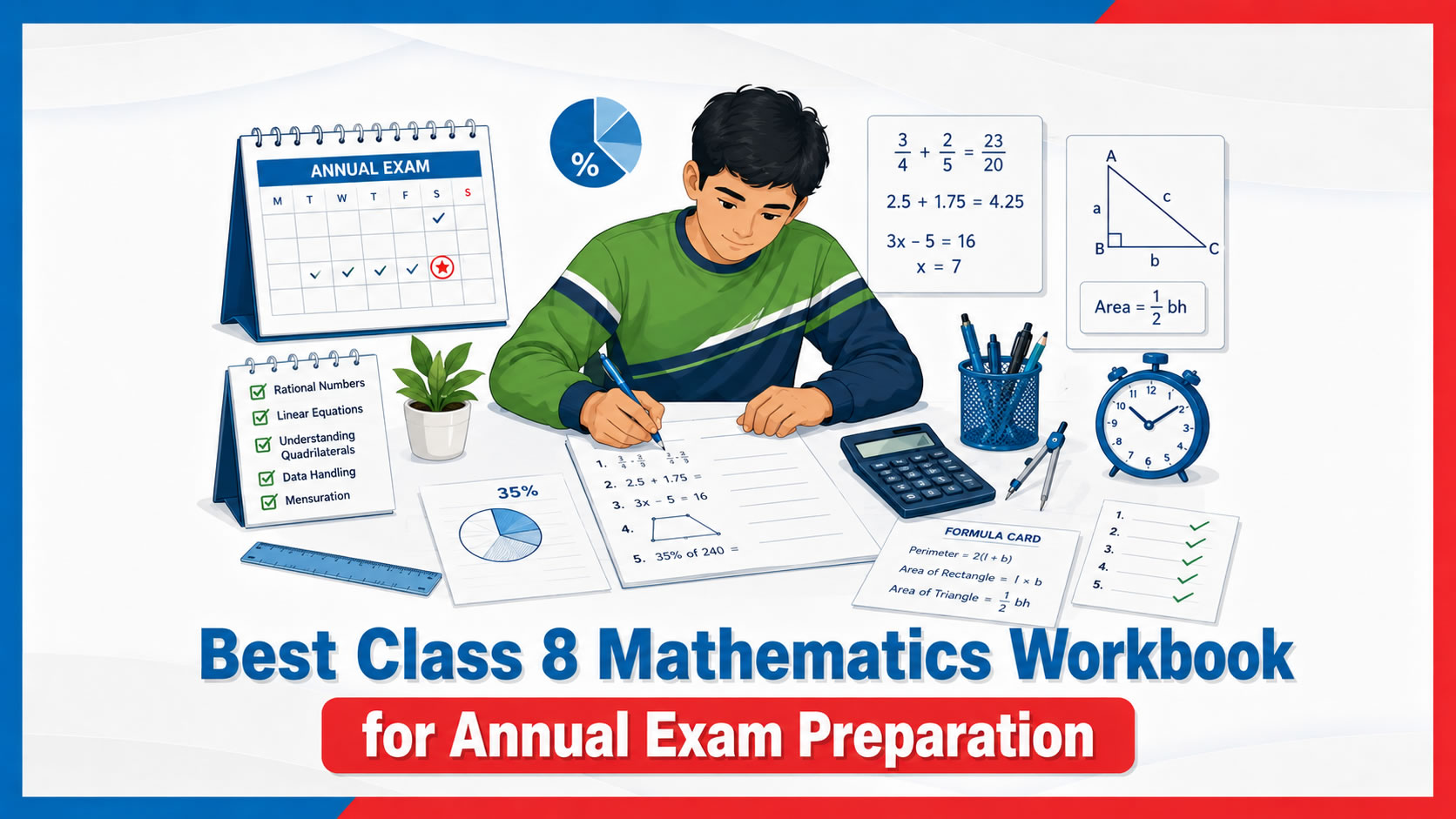
The best Class 8 Mathematics workbook for annual exam preparation combines complete NCERT/CBSE aligned chapter coverage, a mix of MCQs, short-answer, long-answer, and case-based questions, detailed step-by-step solutions, and previous years’ papers. Class 8 sits at an interesting crossroads. It’s basically the last stretch before the high-stakes years of Class 9 and 10. At this stage, subjects like Mathematics start demanding conceptual clarity–algebra identities, rational numbers, mensuration, data handling, and more. For a lot of students, this is the year Maths either clicks into place or starts feeling intimidating.
To excel in the annual exams, simply reading the textbook isn’t enough. Students need to sit for consistent practice with diverse question types, exam-oriented problems, and regular revision to develop both speed & accuracy. That’s where a well-designed Mathematics workbook can make a real difference—it reinforces classroom learning, strengthens conceptual understanding, and helps students gain the confidence needed to perform well in the final examination.
Most students don’t lose marks in the exam hall because they lack knowledge; they lose marks because:
● They’ve never solved a question in that exact format before
● They run out of time because their practice was untimed and unstructured
● They make small calculation slips that go uncorrected because there was no answer key to catch them
● They studied from a book that didn’t match what their board or school actually looks for
A well-designed maths workbook Class 8 fixes all four problems in one go. It doesn’t just give more questions; it gives the right set of questions, organised the right way, with feedback built in.
Before recommending anything, it helps to know what separates an average workbook from an exam-ready one. Here's what to actually check for.
Class 8 Maths typically covers topics such as Rational Numbers, Linear Equations in One Variable, Practical Geometry, Data Handling, Mensuration, and more. A strong Class 8 Maths workbook doesn’t skim through these; it dedicates proper space to each one, with a mix of easy, moderate, and challenging problems. Oswaal’s Class 8 Mathematics workbook is organised this way, giving each chapter its own graded question bank rather than treating the harder, less “exam-favourite” topics like Practical Geometry or Visualising Solid Shapes as an afterthought.
Boards revise blueprints and question patterns periodically. A mathematics workbook Class 8 that’s even a couple of years outdated can quietly mislead a student into practicing the wrong question types or ignoring newly emphasised areas. This is one of the most overlooked but critical factors, and it’s one area where a good math practice book for Class 8 gets the scoring points.
Annual exams today rarely stick to plain question formats. Students need to focus on diverse question types such as Multiple Choice Questions (MCQs), Very Short Answer (VSA), Short Answer (SA), Long Answer (LA), case-based & application-based, assertion-reasoning questions, etc. To give students a structured practice environment, the Oswaal Maths book offers chapter-wise practice with a wide variety of exam-oriented questions, detailed step-by-step solutions, competency-focused exercises, self-assessment tasks, and revision support to prepare confidently for their annual exams.
A workbook without clear, step-marked solutions is just a question bank; it doesn’t add value to the student’s exam preparation. Effective solutions should be presented in an exam-style, step-by-step format, helping students understand the correct approach, avoid common mistakes, and learn how to write answers that can fetch maximum marks.
Previous Years’ Questions & Sample Papers
Workbooks that weave in previous years’ school questions and full-length sample papers let students gain real-exam temperament, which is a must to score well in the exams. In this context, you can trust Oswaal Maths Practice Book Class 8 for your child, which integrates a solid set of previous years’ questions, competency-based & application-oriented questions, detailed step-by-step solutions, and self-assessment tests to help students to excel in their annual exams.
Mind maps, formula sheets, concept videos (via QR codes), and quick-revision notes at the start or end of each chapter can save enormous time during last-minute revision, when re-reading the entire textbook simply isn't practical.
Even well-meaning students end up with the wrong workbook fairly often. A few patterns show up again and again:
Even the best workbook underperforms if used passively. Here's a simple, effective approach:
Class 8 Mathematics isn't just about passing an annual exam; it's about laying the groundwork for how comfortable a student will feel with Maths in the years ahead. One of the means of achieving this result is the right mathematics practice book for Grade 8, along with the regular textbook, that will help your child practice diverse formats of questions, chapter-wise practice, detailed solutions, and revision support, helping them strengthen concepts, build confidence, and perform better in their annual examinations.
For students and parents looking for a dependable companion for the exam season, a workbook that proves to be the perfect choice—Oswaal's CBSE Class 8 Mathematics workbook - that offers extensive practice questions, diverse question formats, mind maps, mnemonics, and more.
Remember, success in Mathematics doesn't come from studying harder at the last minute; it comes from practising smarter every single day. Every question your child solves, every concept he revises, and every mistake he learns from will take him one step closer to success. Encourage them to stay consistent, trust the learning process, and enter the exam hall with confidence. After all, small efforts made every day lay the foundation for big achievements tomorrow.
Choose a workbook that fulfills the latest NCERT/CBSE syllabus requirements, provides chapter-wise practice, written solutions, and exam-based questions. The Oswaal Class 8 Mathematics Workbook is a good option in this regard.
The workbook gives additional practice, reinforces concepts, and makes the child familiar with several forms of questions that are asked in the exam.
It is important to encourage practice, regular revision, and sample paper solving. The secret lies in consistency instead of last-minute preparations.
Look for chapter-wise coverage, detailed solutions, competency-based questions, past years' questions, and revision tools such as mind maps and formula sheets.
The earlier, the better. The workbook should be used along with school lessons because this will help build concepts slowly and reduce stress at the time of the exam.