


Physics 2003 Question Papers Class XII


CBSE Guess > Papers > Question Papers > Class XII > 2003 > Physics > Compartment Outside Delhi Set -I PHYSICS—2003 (Set I—Compartment Outside Delhi) Q. 1. Two stars X and Y with magnitudes m1 and m2 have values of their brightness t 1 and t 2 respectively. Write expression for 
Q. 2. State the reason why soft iron is used in making electromagnets. Q. 3. Two conductors, one having resistance R and another 2R, are connected in turn across a d.c. source. If the rate of heat produced in the two conductors is Q1 and Q2 respectively, what is the value of Q. 4. What should be the length of a dipole antenna for a carrier wave having frequency 3 x 10⁸ Hz? Q. 5. How docs the intensity 'I' of scattered light vary with the wavelength of the incident light? Q. 6. What is a button cell? Mention its two applications. Q. 7. Derive an expression for the mutual inductance of a pair of coaxial solenoids having number of turns N1 and N2 . Q. 8. Briefly explain, how the drift velocity of electrons in a metallic conductor varies, when (i) the temperature of the conductor is increased, and (ii) applied potential difference is decreased, keeping temperature constant. Q. 9. A radioactive nucleus *A' decays as given below: Q. 10. The intensity of solar radiation on the earth's surface is 1.4 x 10³ Wm -2 . Calculate the surface temperature of earth, assuming that it re-emits all the radiations it receives from the sun. Q. 11. State Gauss' theorem in electrostatics. A charge of 17.7 x 10 -4 C is distributed uniformly over a large sheet of area 200 m2 . Calculate the electric field intensity at a distance 20 cm from it in air. Or Electric field intensity at point 'B' due to a point charge 'Q' kept at point 'A' is 24 NC-1 and the electric potential at point 'B' due to same charge is 12 JC-1 . Calculate the distance AB and also the magnitude of charge Q. Q. 12. Name the 2-input logic gate, whose truth table is given below:
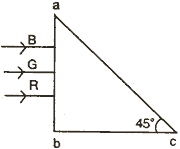
If this logic gate is connected to a NOT gate, what will be the output when (i) A: 1, B = 1 and (ii) A = 0, B = 1? Q. 13. Three light rays red (R), green (G) and blue (B) are incident on a right angled prism 'abc', at face 'ab'. The refractive indices of the material of the prism for red, green and blue wavelengths are 1.39, 1.44 and 1.47 respectively. Out of the three, which colour ray will emerge out of face 'ac'? Justify your answer. Trace the path of green (G) ray after passing through face 'ab'.
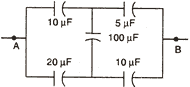
Q. 14. State the postulates of Huygens' wave theory. Sketch the wave front that corresponds to a beam of light (i) coming from a very faraway source, and (ii) diverging radially from a point source. Q. 15. Find the equivalent capacitance between the points A and B of the given combination of capacitors.
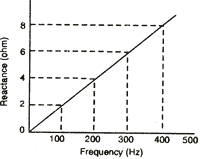
If a battery of e.m.f. 10 V is connected between the points A and B, calculate the total charge in the circuit. Q. 16. Show graphically the intensity distribution of a single slit diffraction pattern. Q. 17. A metallic rod of length 'l' and resistance 'R' is moving normal to a uniform magnetic field 'B' with a velocity V. Deduce expressions for (i) the e.m.f. induced, and (ii) the induced current, in the metallic rod. Q. 18. Figure shows how the reactance of an inductor varies with frequency.
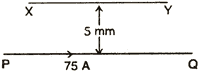
Q. 19. An electric dipole is held in a uniform electric field. Q. 20. A convex lens made of material of refractive index 'n 2 ' is held in a reference medium of refractive index 'n1 '. Trace the path of a parallel beam of light passing through the lens when (i) n 1 = n2 , (ii) n1 < n2 and (iii) n1 > n2 . Q. 21. A long straight conductor 'PQ', carrying a current of 75 A, is fixed horizontally. Another long conductor 'XV is kept parallel to 'PQ' at a distance of 5 mm, in air. Conductor 'XY' is free to move and carries a current 'I'. Calculate the magnitude and direction of current 'I' for which the magnetic repulsion just balances the weight of conductor 'XY'. (Mass per unit length for conductor 'XY' is 10 -2 kg/m)
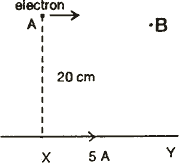
An infinitely long straight conductor 'XY' is carrying a current of 5 A. An electron is moving with a speed of 10s m/s parallel to the conductor in air from point A to B, as shown in figure. The perpendicular distance between the electron and the conductor 'XY' is 20 cm. Calculate the magnitude of the force experienced by the electron. Write the direction of this force.
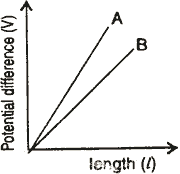
Q. 22. A diamagnetic material and a paramagnetic material of the same shape and size are in turn kept in an external uniform magnetic field. Draw the modification of the magnetic lines of force in the two cases. Q. 23. Mention the frequency at which T.V. signals are transmitted. Q. 24. Briefly explain the following terms: Q. 25. Red light, however bright, cannot cause emission of electrons from a clean zinc surface. But even weak ultraviolet radiations can do so. Why? Q. 26. Draw a labelled circuit diagram of common-emitter amplifier using a n-p-n transistor. Q. 27. State Kirchhoff's laws for an electrical network. Or The variation of potential difference with length in case of two potentiometers A and B is shown in the figure. Which of the two is preferred to find e.m.f. of a cell? Give reason for your answer.
With the help of a circuit diagram, describe how e.m.f.'s of two primary cells can be compared by using a potentiometer. Physics 2003 Question Papers Class XII
CBSE 2003 Question Papers Class XII
|
|