
Social Studies 2007 Question Papers Class X

CBSE Guess > Papers > Question Papers > Class X > 2007 > Social Studies > Outside Delhi Set - I
Social Studies - 2007 (Set I — Outside Delhi )
Q. 1. State any two main objectives of the British Government to spread education in India. (2×1=2 marks)
Q. 2. State two ways by which the Indian people reacted to the partition of Bengal by Lord Curzon. (2×1=2 marks)
Q. 3. Write two points of distinction between renewable resources and non-renewable resources. (2×1=2 marks)
Q. 4. Which is the most important cereal crop in India ? Name the two major producing states of this crop. (1+1=2 marks)
Q. 5. Why is sustainable development essential for economic growth ? Give two reasons. (2×1=2 marks)
Q. 6. How does casteism create hindrance in our social development ? Explain any two points. (2×1=2 marks)
Q. 7. Explain any two man-made factors responsible for landslides. (2×1=2 marks)
Q. 8. Analyse any two situations because of which the European trading companies started interfering in the political affairs of India in the eighteenth century. (2×1=2 marks)
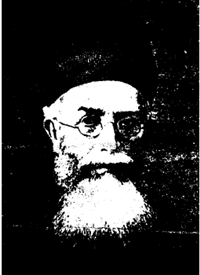
Q. 9. Identify and name the Indian national leader shown in the picture given below. State any two of his contributions in promoting Indian Nationalism. (1+1=2 marks)
Note : The following question is for the Blind Candidates only in lieu of Q. No. 9.
Q. 10. How can Indian agricultural products stand in the world market ? Suggest two ways in this regard. (2×1=2 marks)
Q. 11. Identify the different thrust areas of human development. Which one of them plays the most significant role in the development ? (1½+½=2 marks)
Q. 12. How will you help a person if you find him/her in a burnt state ? Suggest any two ways. (2×1=2 marks)
Q. 13. In which two categories are minerals generally classified ? Give three characteristics of each category. (1+1½+1½=4 marks)
Q. 14. Describe any four privileges enjoyed by minority communities in India. (4×1=4 marks)
Or
State any eight steps which have been mentioned in the Indian Constitution to protect the interests of Scheduled Castes and Scheduled Tribes. (8×½=4 marks)
Q. 15. Make the correct pairs from the two Columns A and B : (4×1=4 marks)
Column A Column B
(Author) (Works)
Somadeva Prithviraj Raso
Kalhana Gitagovinda
Jayadeva Rajataringini
Chandbardai Katha-Sarit-Sagar
Or
Explain any four contributions of Amir Khusrau. (4×1=4 marks)
Q. 16. Explain any four factors which are responsible for decentralisation of cotton industry in India. (4×1=4 marks)
Or
Explain any four measures to control air pollution created by industries in India. (4×1=4 marks)
Q. 17. “Transport routes are called the basic arteries of our economy.” Support this statement with four examples. (4×1=4 marks)
Q. 18. Explain the four measures taken by the Government of India to tackle the problem of poverty. (4×1=4 marks)
Q. 19. How did Non-Aligned Movement (NAM) come into existence as the second largest political formation in the world ? Explain. (4 marks)
Q. 20. What should be the configuration and foundation of an earthquake-resistant building ? Explain two points for each. (2+2=4 marks)
Q. 21. State any six objectives of the ‘National Forest Policy’ regarding conservation of forests in the country. (6×1=6 marks)
Or
Describe any six measures adopted for the conservation of water. (6×1=6 marks)
Q. 22. State the two index numbers used to know the price rise. Describe the four steps taken by the Government of India to control price rise. (2+4=6 marks)
Or
Describe any two features of each of the three strategies adopted by the Government to protect the interests of the consumers. (3×2=6 marks)
Q. 23. Explain any six factors that contributed to the growth of Indian Nationalism during the 19th century. (6×1=6 marks)
Or
Explain any six points regarding the significance of the ‘Revolt’ of 1857. (6×1=6 marks)
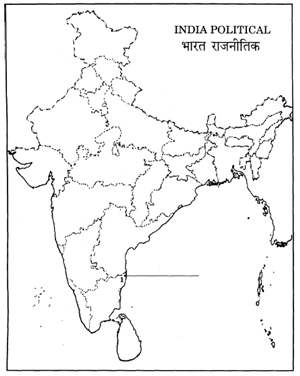
Q. 24. (a) (i) On the given political outline map of India (on page 9) the place is shown by No. 1, where the resolution for complete independence was declared. Identify and write the correct name of this place on the line drawn on the map.
(ii) On the same map of India (on page 9) shade and name the state where the ‘Gol Gumbaz’ is located. (1+1=2 marks)
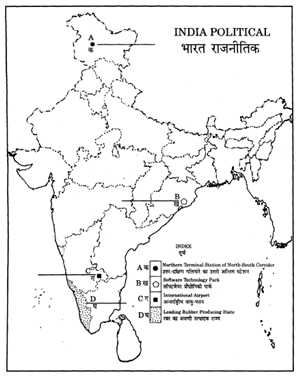
(b) On the given political outline map of India (on page 11) are shown four geographical features A, B, C and D. Identify these features with the help of the map key and write their correct names on the line marked against each in the map. (4×1=4 marks)
Or
On the given political outline map of India (on page 12) locate and label the following geographical features : (4×1=4 marks)
Note : The following question is for the Blind Candidates only in lieu of Q. No. 24 (a) and (b).