
SECTION - A
Reading (20 marks)
Q. 1. Read the passage given below and answer the questions that follow : (12 marks)
1.1 Complete the summary given below. Use only a word to fill in the blanks. (1×5=5)
The author decided to stay put at Bethlehem as he wanted it to be his (a) _____________________ hometown. Though upset about the lack of (b) ___________________, he and his wife started to seek out the good things there. Soon a strong bond developed between them and their (c)___________________. He resisted his (d)_______________________ to move to greener pastures. He also (e)___________________that only with commitment can a lasting community arise.
1.2 Complete the following sentences : (1×3=3 marks)
1.3 Find words which mean the same as the following : (1×4=4 marks)
Q. 2. Read the passage given below and answer the questions that follow : (8 marks)
2.1 Complete the following : (1×4=4 marks)
2.2 Complete the table given below : (1×4=4 marks)
| Year | Events |
| (a) _________ | Recorded history of Coorg available from |
| 1785 AD | (b) ____________________ |
| (c) ________ | Coorg regained independence |
| 1834 AD | (d) ____________________ |
SECTION - B
Writing (30 marks)
Q. 3. You are Akhil / Akanksha, the Head Boy/Girl of Modern Public School, Kochi. As part of Social Service your school has decided to clean the surroundings. Write a notice, in not more than 50 words, for your school notice board asking for the names of the students of senior wing who wish to participate wholeheartedly. (5 marks)
Q. 4. You are Akhila / Akash, a student of R.H. College, Mangalore. Send a telegram to your father living at 20, Church Road, Bangalore informing him that you are unable to come home to attend the wedding of your cousin due to curfew in Mangalore. Write the telegram in not more than 25 words. Copy the format of the telegram from the question paper. (5 marks)
INDIAN POST AND TELEGRAPH
| ADDRESSEE’S NAME AND ADDRESS |
|
MESSAGE SENDER’S NAME |
|
(NOT TO BE TELEGRAPHED) SENDER’S ADDRESS |
|
Q. 5. The following lines from the poem, ‘Reaching Out’ in the Main Course Book set you thinking about the need to educate adults. You decided to get involved in the adult education programme. Taking ideas from the unit, ‘Education’, along with your own ideas, write a letter to the editor of a newspaper in about 150 words encouraging youngsters to take part in the programme. (10 marks)
| "______________despite our illiteracy, We still exist. But we have to know Why we should become literate.” |
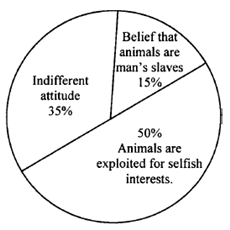
Q. 6. You are a member of the Society for Prevention of Cruelty to Animals in your locality. The following Pie-chart reflects the attitude of the people towards animals. In response to this, write an article to be published in the forthcoming issue of ‘The Week’ on why animals are ill treated and what can be done to prevent it. As Ramesh / Ranjini, write the article in 150-200 words. (10 marks)
FOR THE BLIND
You are a member of the Society for Prevention of Cruelty to Animals in your locality. Write an article to be published in the forthcoming issue of ‘The Week’ on how animals are ill treated and what can be done to prevent it. As Ramesh / Ranjini, write the article in 150-200 words.
Hints :
* 50% people believe that animals are exploited for selfish ends.
* 35% people have indifferent attitude towards animals.
* 15% people believe that animals are man’s slaves.
SECTION - C
Grammar (20 marks)
Q. 7. Look at the notes given below and complete the paragraph suitably. Do not add any new information. Write the answers against the correct blank numbers in your answer sheet. Do not copy the whole sentences. (1×4=4 marks)
| Susrutha - birth - 6th Century - learns surgery, medicine - Dhanvanthri - Varanasi - Susrutha, other doctors - realize - no point - learn - only facts - from books - perform - surgery - |
Susrutha was a descendant of the Vedic sage Viswamithra. He was (a) __________ the 6th century B.C. He (b)______________from Dhanvanthri at Varanasi. Susrutha and some other (c)________________that learning only facts from books was of very little use by itself. In order to be good surgeons, they needed to learn by (d)______________
Q. 8. Rearrange the following words and phrases to form meaningful sentences. The first one has been done for you as an example. Write the answers against the correct blank numbers in your answer sheet. (1×4=4 marks)
was a / about twenty / childhood / delight / years ago.
Childhood was a delight about twenty years ago.
Q. 9. In the passage given below, there is an error in each line. Write the incorrect word and the correction as given in the example against the correct blank number in your answer sheet. Remember to underline the word you have supplied. (½×8=4 marks)
| The exhaust earth groaned | exhaust - exhausted |
| and quivered under a glare | (a) |
| of the Sun. Spirals in heat | (b) |
| rose from the ground on if | (c) |
| from molten lava. The panting | (d) |
| lizard crawl painfully over | (e) |
| the hot rock on search | (f) |
| of the shady crevice. Cattle | (g) |
| or dogs cringed under the shade. | (h) |
Q. 10. Read the headlines given below and use the information to complete the sentences appropriately. Write the answers against the correct blank numbers in your answer sheet. Do not copy the whole sentences. (1×4=4 marks)
Q. 11. Read the conversation and complete the paragraph given below. Write the answers against the correct blank numbers. Do not copy the whole sentences. (1×4=4 marks)
Arun : Where are you going ?
Hari : I am going to Mumbai.
Arun : Do you know whether the train is on time ?
Hari : It is to arrive at 10 p.m.
Arun : I hope it is on time.
Arun asked Hari where he was going. Hari answered that (a) ________.
Arun enquired if he knew (b)_________________________.
________________________ Hari said (c) ____________________________.
Arun said (d)________________.
SECTION - D
Literature (30 marks)
Q. 12. Read the extract given below and answer the questions that follow. Write the answers in your answer sheet in one or two lines only. Number the answers correctly. (4 marks)
Like the bright hair uplifted from the head
Of some fierce Maenad, even from the dim verge
Of the horizon to the zenith’s height,
The locks of the approaching storm.
Q. 13. Read the extract given below and answer the questions that follow. Write the answers in your answer sheet in one or two lines only. Number the answers correctly. (4 marks)
Dumbstruck sat the gaping frog.
And the whole admiring bog
Stared towards the sumac, rapt,
And, when she had ended, clapped.
Q. 14. “We were the first that ever burst Into that silent sea.”
Give a description of the experiences the mariners underwent in ‘the silent sea’. Write your answer in 75-100 words. (5 marks)
Q. 15. Why did Calpurnia try to prevent Caesar from going to the senate house ? Did she succeed in her attempt ? Why ? Write your answer in about 75 words. (5 marks)
Q. 16. “But when the evening of his life was drawing in, he left his old ways and suddenly took a new turn.” What was the change in Ali’s nature towards the end of his life ? What was responsible for this transformation ? Write your answer in 50-75 words. (4 marks)
Q. 17. You are the reporter of an investigative magazine. Your editor entrusted you with the duty of collecting information about what had happened to Cutie-Pie after he had escaped from prison. After the investigation you decide to write a letter to a friend on what had happened to Cutie-Pie. Write the letter in 150-175 words. (8 marks)