
SECTION A (READING)
A1. Read the following poem carefully. (8 marks)
NIGHT
The Sun descending in the west,
The evening star does shine;
“The birds are silent in their nest,
And I must seek for mine.”
The Moon, like a flower,
In heaven’s high bower,
With silent delight
Sits and smiles on the night.
Farewell, green fields and happy groves,
Where lambs have nibbled, silent moves
The feet of angels bright;
Unseen they pour blessing,
And joy without ceasing,
On each bud’ and blossom,
And each sleeping bosom.
“They look in every thoughtless nest,
Where birds are covered warm;
They visit caves of every beast,
To keep them all from harm.”
If they see any weeping
That should have been sleeping
They pour sleep on their head,
And sit down by their bed. William Blake
A1.1 Below is the summary of the poem. Complete it by writing the missing word phrase against the correct blank number in your answer sheet. (½x 6 = 3 marks)
This poem conveys a beautiful impression of peace and quietness that falls over the landscape at (a) …………… At this time there is (b) ……………….. everywhere. The poet compares the moon to a (c) ………… It appears to be silently sitting and (d) …………. during the night. The poem conveys a feeling of trust in God’s protection. His (e) ……………... angels whose feet are bright, shower (F) ……………… of safe sleep on all.
A1.2 What do the angels do to the following, when they visit them at night? Write the answers in your answer sheet against the correct blank numbers. (3 marks)
(a) birds in their nests …………….
(b) beasts in their caves ……………..
(c) any weeping creature ………………
A1.3 Find words I phrases from the poem which mean the same as the following. (2 marks)
(a) areas of land with fruit trees of particular type
(b) took small bites of food
A2. Read the following passage carefully. (12 marks)
1. Summer vacation offers families dilemmas and opportunities. For too many kids it becomes a period of intellectual passivity and stalled personal growth. For others—and their parents—.it’s a time of overload and frantic scheduling.
2. “Summer is a great time for parents to build relationship with their children,”
says a renowned child psychologist. And it’s an opportunity both for the kids to learn and for the family to grow together. To make this a reality, educators and psychologists point to several simple strategies that parents can start planning before summer gets under way.
3. “Summer’s a perfect time for kids to take skills they’ve learnt in a class-room and use them in new ways,” notes a well known educator. Comparing prices in a grocery shop can sharpen children’s mental maths skills. Taking measurements to build a new tree house or design a simple plaything teaches geometry. Car trips provide opportunities to study maps and learn geography. Some libraries offer free summer reading programmes for children.
4. Sometimes kids will need a small push in the right direction. Victoria encouraged her seven- year-old son, Philip, to take part in their local library’s summer reading club. For every book report a child wrote, he received a raffle ticket. At the end of the summer, sports prizes were raffled off. Philip, who’d painstakingly produced seven book reports, won an autographed picture of a hockey star and had his name and one of his reports printed in the local newspaper. (If that’s not possible, encourage children to write letters to editors on current affairs, or about school-related issues.) “Philip moaned and groaned about writing the reports, but in the end, he was happy he put the effort in,” notes his mother. “And his ability to express himself really improved.”
5. It’s the daily doses of stimulation—intellectual, creative, esteem-building——that parents can give their children that have the greatest impact, ”says an eminent researcher. In an informal study conducted in 1998 other researches surveyed successful college students about how they spent their free time from ages five to 12, then compared their activities with those of troubled youngsters. They found that the successful ones were more likely to play spontaneous games, more involved in household chores and more likely to engage in playful activities with their parents. Troubled youngsters spent far less time on chores or family games and more time on their own, planted in front of the TV or a video game.
6. Often, when parents are drawing up their summer plans, their focus is on entertaining and enriching their children. But experts agree that a summer built completely around a child’s self- fulfilment won’t help a youngster mature into a high thinking, caring member of his family or community. Truly successful kids, say educators, are those who’ve learnt to budget time to help others—whether it’s helping an invalid neighbour or preparing their own family’s meals a couple of nights a week. Where parents fail, say experts, is in the way such responsibilities are presented. Too often, they’re trotted out as punishments instead of challenges. To make matters worse, parents often nag the child about the task, rather than simply setting a completion deadline and allowing the youngster to decide when and how he will meet it.
7. For most parents of school-age kids, the largest block of time they’ll have with their children is in the summer. With a little advance preparation, parents can use the summer to help develop their youngsters into smarter, more creative, more caring human beings.
A2.1 On the basis of your reading of the passage above complete the following sentences. Write the answers in your answer sheet against the correct blank numbers. (9 marks)
(a) Parents can give the kids a special summer vacation by (2)
(i)................. (ii) ………….
(b) Mention the new ways in which children can use the skills learnt in class (2)
(i) …………. (ii) ………….
(c) The advantages Philip had on writing the book reports were (2)
(i) ………… (ii) ………….
(d) Truly successful kids are those who …………. (1)
(e) Why should a summer vacation not be built completely around a child’s
fulfilment? (1)
(f) Parents who prepare for the summer vacation in advance can ensure that
their children ………….. .
A2.2 Find words / phrases from the passage which mean the same as the following from the paragraphs indicated. (3 marks)
(a) done quickly, not organized (para 1)
(b) plans (para 2)
(c) concentrate (para 3)
SECTION B (WRITING)
B1. Mohak is on a holiday in Goa. After visiting some places, he made some notes in his diary. Use the information in these notes to complete the post-card which he sent to his friend. Do not add any new information. Write the answers in your answer sheet against the correct blank
numbers. (5 marks)
NOTES
| GOA arrival 27 Jan. wonderful place — no crime people friendly, happy-go-lucky landscapes : picturesque; beaches : beautiful good restaurants : sea food (mostly) hotel : on beach tours : bus, ferry Carnival festival colour, fun and frolic. |
Panaji
3 March, 2Oxx
Dear Vikram
I’m having a nice time here in Goa. I reached this beautiful place on 27 Jan. Can you believe, this place is totally free (a) ……..……….. ? What makes this place so wonderful is not only the beautiful beaches and picturesque landscape but also its people (b) …………….happy-go-lucky. The restaurants here are (c) ……….mostly sea food. The hotel we are staying in is situated on a beach so we (d) ………….. The carnival festival is the best thing about Goa. It (e) …………….and frolic. There are still many places for me to see. I’ll show you the photos when I meet you.
With love
Yours affectionately
Mohak
B2. Read the following telephonic conversation which took place between Sheela and Reghu. As Reghu’s sister Rani is not at home and he himself has to go out of his house immediately, he writes a message for his sister.
Write the message from Reghu to his sister Rani in not more than 50 words. Put the message in a box.
(5 marks)
Sheela : Hello ! Could I speak to Rani.
Reghu : May I know who is speaking. Rani has gone out. This is her brother,
Reghu speaking.
Sheela : I am her friend, Sheela. Could you tell her that one of our friends,
Tina has met with an accident and is admitted in St. Mary’s hospital.
Reghu : Oh, how unfortunate.
Sheela : Tell her that I am leaving for the hospital as the visiting hours are
between 4 pm and 6 pm.
Reghu : I’ll definitely convey the news.
Sheela : Also tell her to inform Balu whose telephone number I am not sure
of.
Reghu : I’ll do that.
Sheela: Thank you.
B3. Philip is a class X student. He happened to read the following newspaper article. He decided to write a letter to the editor of ‘The Indian Times’ giving his strong views on the health hazards caused by pesticides. Using ideas from the unit on ‘Health and Hygiene’, together with your own ideas, write the letter in not more than 150 words. (10 marks)
THERE IS POISON IN YOU It’s there in your water, milk, fruits, vegetables, eggs, meat, flour and now soft drinks. For sometime now evidence about the harmful effect of pesticides has been mounting. From brainless babies in one part of the country and cancer cases in the other part, it’s been an unending saga of death and misery. |
THERE IS POISON IN YOU
It’s there in your water, milk, fruits, vegetables, eggs, meat, flour and now soft drinks. For sometime now evidence about the harmful effect of pesticides has been mounting. From brainless babies in one part of the country and cancer cases in the other part, it’s been an unending saga of death and misery.
B4. Sheshadn is a boy who has survived more than 25 major accidents; it makes you wonder about the cause of accidents in the Indian cities. You decide to write an article for the school magazine titled ‘Driving India Crazy’. Taking ideas from the data below and your own ideas
write the article in about 150-200 words. (10 marks)
Number of persons killed in cities.
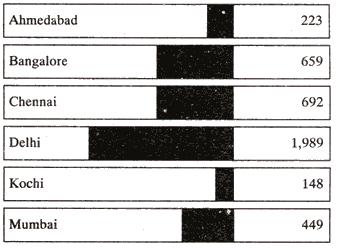
“Admittedly, there is not a bone in his body that was not broken at some point or the other”. This report on Sheshadri, who has survived more than 25 major accidents makes you wonder about the cause of accidents in the Indian cities.
Write an article titled ‘Driving India Crazy’ for the school magazine.
SECTION C (GRAMMAR)
C1. The following passage has not been edited. There is one error in each line. Write the incorrect word and the correction in your answer sheet as given below against the correct blank number. Remember to underline the word that you have supplied. (½ x 8 =4 marks)
The ancient Greeks revered honey so much as e.g. as……so
that much playwrights conveyed the (a)
luxurious lifestyle with the Athenians (b)
with its description of cheese cake (c)
eaten with honey. Honey be known not (d)
only for its sweet and also for (e)
its soothing qualities. Unless sugar (f)
became commonplace in a late 18th (g)
century, honey is also used in traditional remedies. (h)
C2. In the passage given below, one word has been omitted in each line. Write the missing word along with the word that comes before and the word that comes after it in your answer sheet against the correct blank number. Ensure that the word that forms your answer is underlined. (½X8= 4 marks)
The television has always very controversial. e.g. always been very
While the positive aspects the electronic (a)
media innumerable, their negative (b)
impact children cannot be denied. (c)
For new piece of information that (d)
a child learns the Discovery or National (e)
Geographic channel, are also (f)
unrealistic stunt shows parents dislike. (g)
Computers and TV have students to lose (h)
interest in studies.
C3. Look at the words and phrases below. Rearrange them to form meaningful sentences. The first one has been done as an example.
Write the correct sentences in your answer sheet against the correct blank numbers. (½x 6 =3 marks)
is it/that / attracts I so many / to it / about prayers / people / what I?
What is it about prayers that attracts so many people to it?
(a) offer / peace / of hope I and / of mind / a lot / prayers.
(b) anything / the faith / they give / to believe / can / that I happen I you.
(c) an / ought / with / honest / heart / offered / prayers / to be.
(d) most / and / swamps / spent / rivers / they I so I their time / of / in I
(e) blow out / but / used to I they / we / candles / light a lamp
(t) weighed / against grain / him / parents / my grandfather’s
C4. Look at the newspaper items below. Then use the information in the headlines to complete the paragraphs. Write the answers in your answer sheet against the correct blank numbers. Do not copy the whole sentence. (4 marks)
(a) UK EMBASSY IN IRAN CLOSES AFTER ATFACK
London Britain temporarily in Tehran on Wednesday after shots were fired
at it from the street.
(b) NEPALESE WORLD MISS UNIVERSITY
Kathmandu : A Nepalese, class 12 student, Ayusha Shrestha 17 2002
pageant held in Seoul, South Korea.
(c) IRAQI COP KILLED, 20 INJURED
Baghdad : A car bomb exploded today at a police station in Baghdad’s main police compound in Rasafa district , a US Military spokesman said.
(d) REWARDS FOR THAKUR
Ace striker of the world cup winning Indian Junior Hockey team, Deepak
Thakur by his home State, Himachal Pradesh.
C5. Read the following conversation and complete the paragraph. Write the answers in your answer sheet against the correct blank numbers. (5 marks)
Attendant : A person wants to see you, Sir.
Principal : Did you ask him his name?
Attendant : Sorry I didn’t I shall go and ask him.
Principal : Yes, and let me know soon who he is?
The attendant respectfully told the Principal (a) ……...The Principal wanted to know (b) …………The attendant (c) …………. and (d) …………..The principal (e) …………….
SECTION D (LITERATURE)
D1. Read the extract given below and answer the following questions. Write the answers in your answer sheet in one or two lines only. Remember to number the answers correctly. (4 marks)
‘Down dropt the breeze, the sails dropt down,
‘Twas sad as sad could be,
And we did speak only to break
The silence of the sea!’
(a) Who are the “we” referred to here? (1)
(b) Why were they sad? (1)
(c) What did they believe was the reason for their misery? (2)
D2. Read the extract given below and answer the following questions. Write the answers in your answer sheet in one or two- lines only. Remember to number the answers correctly. (4 marks)
I remember the night my mother
was stung by a scorpion. Ten hours
of steady rain had driven him
to crawl beneath a sack of rice.
(a) Who does ‘him’ refer to? (1)
(b) Why did it come in the house? (1)
(c) Why does the poet remember that night? (2)
D3. What are the traits of Caesar that are evident from the play ‘Julius Caesar’? Your answer should not exceed 100 words. (5 marks)
D4. Read the extract given below and answer the following questions. Write the answers in your answer sheet. Remember to number the answers correctly. (5 marks)
“I’ve come to bring you home, dear brother. Father’s not mean any more and he says you’re never coming back here, and from now on we’ll always be together.
(a) Who is the speaker of these lines? (1)
(b) What light do these words throw into Scrooge’s past? (2)
(c) Why did Scrooge feel guilty while watching this scene? (2)
D5. Why did Au give up hunting? Your answer should not exceed 75 words. (4 marks)
D6 Cutie—Pie was extremely attached to his mother. Give incidents from the lesson to prove this
statement. Your answer should be in about 150-175 words. (8 marks)