
Q. 1. What was the Capital of the Pallavas? Mention the famous temple built by them. 2
Q. 2. Name two important literary works of the Gupta period with their authors’s names. 2
Q. 3. Study the map given below and answer the following questions:
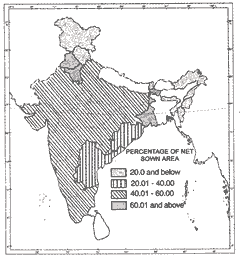
(a) What is the percentage of net sown area in Punjab and Nagaland respectively? 1
(b) Give two major reasons for these variations in their net sown area. 1
(The following question is for Blind Candidates only in lieu of Q. No. 3)
Or
Why does the net sown area vary from State to State. Give two reasons with examples. 2
Q. 4. Write the temperature soil and rainfall conditions necessary for the growth of a beverage crop which is mainly grown in Assam. 2
Q. 5. Distinguish between the following:
Forest area and Forest cover. 2
Q. 6. Write four objectives of conservation of forest resources as set by National Forest Policy. (½x4=2)
Q. 7. What is a ‘Biosphere Reserve’? How many biosphere reserves do we have and how many wild life sanctuaries have been developed in lndia? 2
Q. 8. Why is the need for water evergrowing? Give four reasons. (½ x4=2)
Q. 9. What are the four main factors of production? (½ x4=2)
Q. 10. What is meant by bilateral agreement? 2
Q. 11. Analyse two main adverse effects of growing population on Indian economy. 2
Q. 12. Explain briefly any two main ideals before the Indian Nation after independence. 2
Q. 11. Explain two main reasons for the strained relations between India and Pakistan. 2
Q. 14. Describe the steps taken by Raja Rammohan Roy for improving the status of women in India. 4
Q. 15. What were the main features of British Education Policy in India in the 19th century? 4
Or
Mention four main causes of Revolt of 1857. 4
Q. 16. Write two characteristic features of each of the following:
(a) Dry land farming
(b) Green Revolution
(c) Animal Husbandry
(d) Institutional reforms in agriculture. 4
Q. 17. What do we mean by world labour market? 4
Q. 18. What are the duties of consumers to safeguard their rights? 4
Q. 19. State three schemes through which we can promote the objectives of social justice. 4
Q. 20. What were the main demands of the Indian National Congress during the first 20 years of its formation? Mention the names of any four prominent leaders of the Congress during that period. 6
Q. 21. (a) What are the main differences between commercial energy, non-commercial energy and non-conventional sources of energy. Also give two examples of each. 3
(b) Write three main functions performed by GAIL. What is the full form of GAIL? 2
(c) What is the difference between LPG and CNG? 1
Q. 22. (a) What is Rain Water Harvesting? Write four major objectives of rain-water har vesting.
(b) Write any three low cost techniques which are available to recharge ground water aquifers.
(c) Write any three points which should be kept in mInd for efficient management of water. (3+1½+1½=6)
Q. 23. What do you understand by means of communication? Write about the two main categories of means of communication in detail. Give two advantages of each. 6
Or
Write three points to stress the importance of railways in India. Write six facts about Indian railways and its fleet. 6
Q. 24. Explain the importance of cottage industries in the rural economy of India by giving four examples. 6
Q. 25. Explain the importance of imports and exports in the development of the country’s economy by giving three examples. 6
Q.26. What is communalism? Mention various factors which are responsible for the growth of communalism in India. 6
Or
What is meant by cross border terrorism with special reference to Jammu and Kashmir?
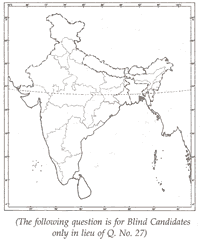
Q. 27. (a) On the given outline map of India locate and name any two of the following centres where the following incidents took place: 2
a. The place where Gandhji took up the cause of the Indigo planters.
b. The city where the Jallianwala Bagh Massacre took place.
c. The village in Gujarat where Sardar Patel led a Satyagraha of the farmers.
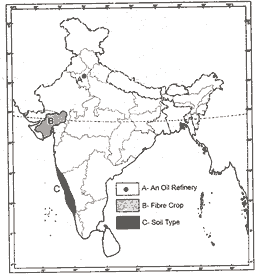
(b) On the given outline map of India, identify the features marked as A, B and with the help of the maps legend and write their names correctly in the space provided. 3 x 1=3
(d) On the given outline map of India locate and label the features given below:
a. Kalpakkam Nuclear Power Station
b. Vishakhapatnam sea-port.
c. An important centre of cotton textile industry of Uttar Pradesh. 3 x 1=3
(The following question is for Blind Candidates only in lieu of Q. No. 27)
Q.27. (a) Name a Nuclear Power Plant situated in Tamil Nadu. 1
(b) Name the major sea-port of Andhra Pradesh. 1
(c) Name an important centre of cotton textile industry in Uttar Pradesh.1
(d) Name the fibre crop which is mainly grown in Gujarat. 1
(e) Name an oil refinery of Haryana. 1
(f) Name a soil type found along the western coast which is heavily leached. 1
(g) Analyse two impact of the Partition of Bengal on the Freedom movement in India. 2